Every few months a friend or a Reddit thread reminds me that Acorns, Chime, or my own bank's round-up feature has "saved" them a surprising chunk of money without them noticing. And every time, I get curious enough to pull out a calculator, because "surprising" and "actually meaningful" are two very different claims. I've written before about subscription-cancellation apps and whether they deliver on their promise, and round-up savers deserve the same honest audit — because the marketing around them leans hard on the word "effortless" while quietly skipping the word "small."
Round-up apps work on a simple premise: every time you buy something with your linked card, the purchase gets rounded up to the nearest dollar, and the difference gets swept into savings or investing. Buy a coffee for $4.35, and sixty-five cents goes into your account. It feels like free money because you never "decided" to save it. The question worth asking isn't whether it works — it obviously does, mechanically — but whether it works well enough to be your actual savings strategy, or just a nice bonus on top of one.

Photo by DΛVΞ GΛRCIΛ on Pexels
The math nobody puts in the app store screenshots
Here's the thing about spare change: it's spare for a reason. The average round-up on a card swipe is somewhere between 25 and 75 cents, depending on your spending habits. If you're someone who swipes a card 15-20 times a month — groceries, gas, coffee, a few online orders — you're looking at roughly $5 to $15 in round-ups monthly. That's not nothing, but it's also not going to fund an emergency fund on any kind of reasonable timeline.
Say you swipe your card 20 times a month and average 50 cents per round-up. That's $10 a month, or $120 a year. Compare that to just setting up a recurring $50 automatic transfer on payday — something you could do in the same banking app without linking a third-party service. You'd hit that $120 mark in about ten weeks instead of twelve months.
I'm not saying $120 a year is worthless. I'm saying the app is selling you a feeling of effortless progress, and the actual dollar amount is closer to "found money" than "a plan." If round-ups are the entirety of someone's savings strategy, that's the part that worries me.
Where round-ups genuinely earn their keep
None of this means skip them. Round-up apps are good at exactly one thing: converting spending behavior you're already going to do into savings behavior you'd never remember to do manually. That's a real advantage, especially for people who find every other savings method too effortful to stick with.
They tend to work best as:
- A supplement layered on top of a real automatic transfer, not a replacement for one
- A low-stakes way to build the habit of "money moves without me touching it" before graduating to bigger automated amounts
- A way to fund something specific and small — a gift budget, a "fun money" account, a short trip — where the timeline doesn't matter much
Where they fall short is anything with a deadline or a target that matters: emergency funds, debt payoff, a house down payment. Those need amounts you actually calculated, not amounts your coffee habit happened to generate.
The multiplier feature that's worth a second look
Several of these apps — Acorns is the best known, but plenty of banking apps now copy the feature — offer a "multiplier" that lets you round up 2x, 3x, or 10x instead of just to the nearest dollar. This is quietly the more useful setting, and almost nobody adjusts it from the default.
Take that same $4.35 coffee. At a 10x multiplier, instead of rounding to $5.00, the app treats it like you spent $4.35 and rounds the *round-up* itself up by 10x — turning a 65-cent save into $6.50. Do that across 20 monthly purchases and you've gone from $10 a month to closer to $100. Now it's a real savings mechanism instead of a curiosity.
The catch is obvious once you say it out loud: at that point you're not saving "spare change" anymore, you're setting a recurring transfer disguised as one, and you should just compare it honestly against a plain automatic transfer instead of paying whatever monthly fee the app charges to do it for you.
Watch the fee, not just the flow
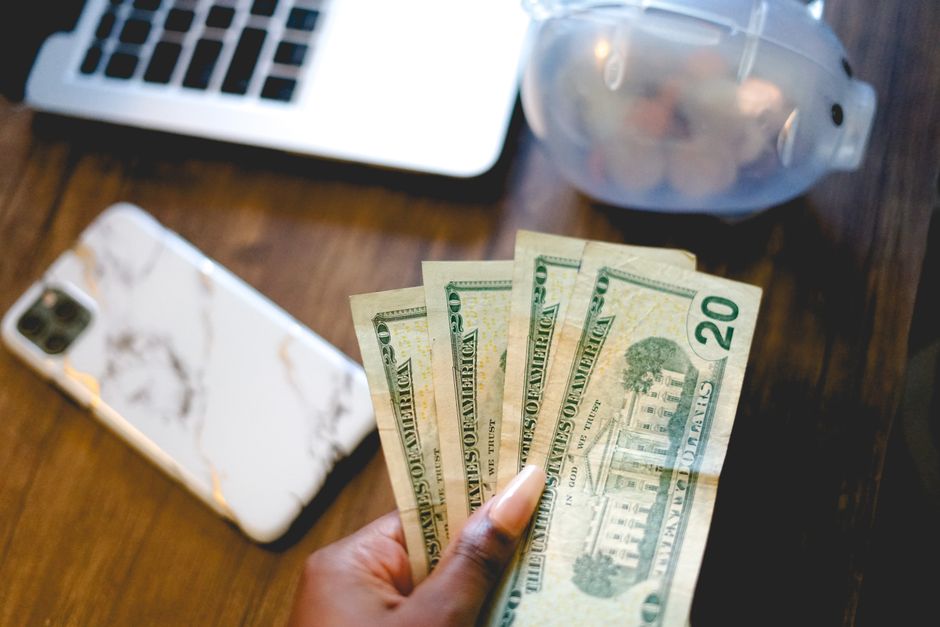
Photo by Joslyn Pickens on Pexels
This is where I'll push back on the category a bit. A lot of round-up apps charge a flat monthly fee — often $3 to $5 — regardless of how much you're actually saving. On $120 a year in round-ups, a $36 to $60 annual fee is eating 30-50% of what you put in. That math gets worse, not better, the smaller your round-ups are.
If your bank offers round-up savings as a built-in, no-fee feature — a lot of them do now — that's almost always the better version of this idea. You get the same behavioral trick without paying rent on your own spare change. Only reach for a paid third-party app if it's genuinely doing something your bank can't, like investing the round-ups into a diversified portfolio rather than just parking them in a savings account.
A quick example to make it concrete
Say you take home $3,800 a month and you're already covering bills with room to spare. You turn on round-ups at your bank, no fee, standard 1x. Over a year that's maybe $100-150 sitting in savings you didn't plan for — genuinely nice, genuinely painless. Now say you also set up a $75 automatic transfer on the 1st and 15th. That's $1,800 a year, deliberately chosen based on your actual budget. The round-ups are the seasoning. The automatic transfer is the meal. Confusing which one is doing the real work is the mistake I see people make most often.
FAQ
Do round-up apps actually help me save more than I would otherwise?
For most people, yes, marginally — because the money moves before you can spend it, which beats good intentions every time. But the amounts are usually small enough that they work better as a supplement to deliberate automatic savings than as a strategy on their own.
Is it worth paying a monthly fee for a round-up app?
Only if it's doing something meaningfully different from a free version — like investing your round-ups rather than just saving them, or if you specifically want it separate from your regular bank account. If your bank offers the same feature free, start there and see if you actually miss anything.
Should I increase the round-up multiplier instead of setting up a separate transfer?
You can, but be honest with yourself about what you're doing: at higher multipliers you're essentially creating a manual recurring transfer with extra steps. It's fine if it works for you, but don't assume it's more "automatic" or effortless than just scheduling a transfer directly.
The takeaway
Round-up savings apps aren't a scam and they aren't magic — they're a small, genuinely useful nudge dressed up in marketing that makes them sound bigger than they are. Use them if the idea of saving without deciding to save appeals to you, keep an eye on whether you're paying a fee for something your bank already offers free, and don't let the good feeling of "effortless" saving replace the boring, deliberate automatic transfer that's actually going to get you where you're trying to go. Systems beat willpower, but only the systems sized to the goal.
Comments
Post a Comment